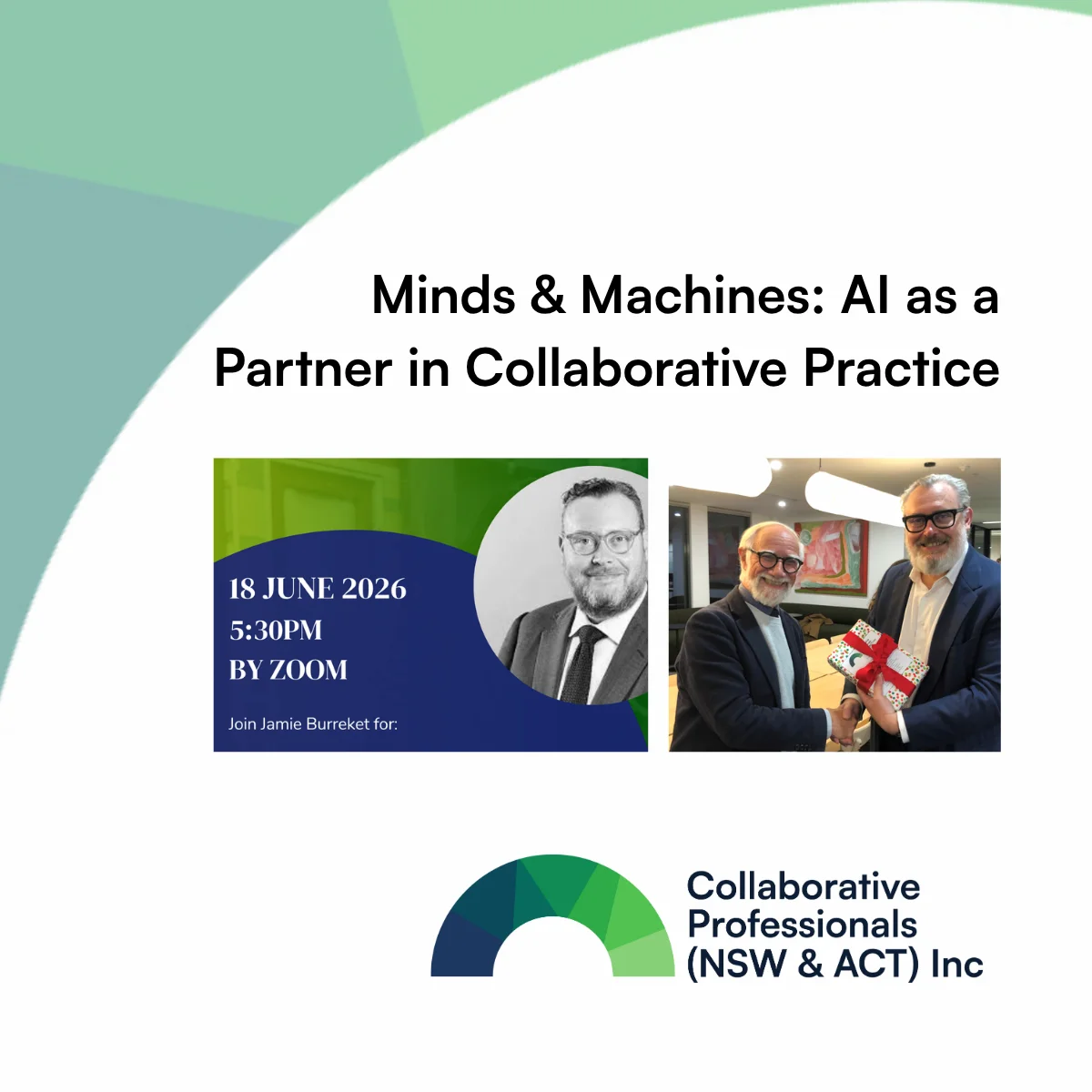
Jamie Burreket’s recent presentation for CP(NSW&ACT) members explored what artificial intelligence might mean for collaborative professionals. Drawing on his experience in both adversarial and collaborative practice, Jamie examined the technology through the lens of dispute resolution rather than legal technology alone.
We began with an exercise, not a lecture. Jamie asked the room to be honest with themselves: write down if you’re excited about AI, then write down if you’re terrified of it. Anyone who ticked both boxes, he suggested, was in good shape – that ambivalence is probably the sensible response.
It’s hard to think of another technology that inspires such enthusiasm and apprehension in equal measure. Jamie opened by examining the pace of AI’s development, the scale of investment driving it, and the capabilities already emerging – context for the argument that followed.
For many years, he observed, the legal profession’s “moat or defensibility” has rested on technical knowledge and expertise. Lawyers have traditionally held specialist knowledge that wasn’t readily available elsewhere. AI is changing that. As that knowledge becomes commoditised, he argued, what a firm really offers its clients going forward is trust and, ideally, something beyond trust: practised wisdom.
“I always see collaborative practitioners as problem solvers first and foremost,” he said. “You’re all very much driven to solve a larger problem about helping families” and he was interested to see how collaborative professionals might use AI in that task. As Jamie put it, “there’s ways you can do it that you’ve never been able to do before.”
Three demonstrations followed, each built around a practical problem.
The first addressed a challenge familiar to many collaborative practitioners: helping clients identify their interests, needs and concerns before their first five-way meeting. Jamie built, live, a simple web-based application to guide clients through that process. Rather than asking about INCs directly, it opened with a more accessible question – something closer to “what’s the single thing weighing heaviest on you right now?” From there, a series of prompts gradually surfaced the priorities that would inform the collaborative discussions – a practical demonstration of how AI might help clients do some of the difficult thinking before they enter the room.
The second demonstration shifted from helping clients, to supporting practitioners. Describing AI as a “thinking partner,” Jamie showed how it could assemble a virtual panel of advisers, drawing on published expert work, to help work through moments where a collaboration has stalled – an intractable position between the parties, say, or difficulty landing on the right interests, needs and concerns. The exercise generated a range of perspectives for consideration.
The third demonstration came without a live build but pointed furthest ahead: Jamie’s account of AI in the room itself – taking minutes, producing a memo within moments of a session ending, drafting follow-up emails to relevant experts, even pulling live answers to questions as they’re raised, from comparative property prices to spending figures buried in a client’s own financial documents. It was a fascinating glimpse of where he sees this heading next and of what practitioners might do with the time they get back.
The final audience question was the one many in the room were probably already asking themselves: so, where do you begin?
Jamie’s advice was to start small and make it personal. He described using AI to negotiate the replacement of a stone in his wife’s engagement ring – it was enough to get him hooked. From there, pick something ordinary, an energy bill or an everyday task, and see what it can do. The next step, he suggested, is metaprompting: if you don’t know how to frame a request, ask the AI to build the prompt for you, then run it. “You’ve really just got to get imaginative,” he said, “and put the problem back on the AI. The important thing is simply to begin.”